Imagine walking onto a major television stage alone, taking the microphone, and performing a song normally sung by two world-class vocalists. Now imagine switching between two dramatically different vocal registers so convincingly that the audience begins to wonder how one person can produce both sounds.
That is the extraordinary talent Marcelito Pomoy brought to America’s Got Talent: The Champions in 2020.
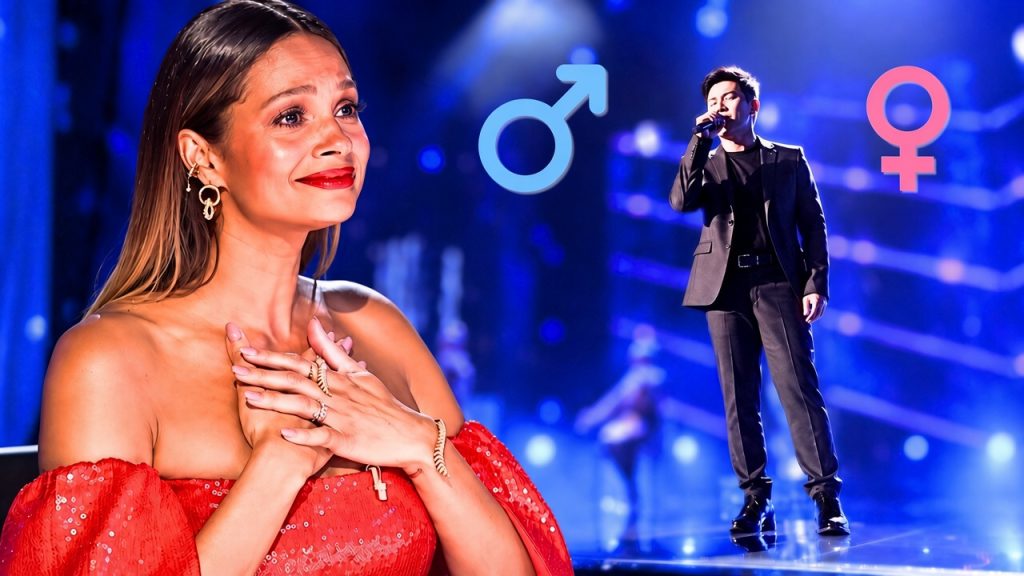
The singer chose “The Prayer,” the beloved duet associated with Andrea Bocelli and Céline Dion. Rather than selecting one part and leaving the other to an unseen musical arrangement, Marcelito performed both sides himself, shifting between a rich male voice and a remarkably high soprano-style register.
The judges watched as the performance moved between the two vocal styles. By the end, Simon Cowell had given him an emphatic compliment, while all four judges stood to applaud.
What began as an unusual singing act became one of the memorable vocal moments of the season.
Meet Marcelito Pomoy, the Singer With Two Distinct Vocal Registers
Marcelito Pomoy is a singer who became widely known for his ability to move between contrasting vocal registers. His performances can create the impression of a male and female vocalist sharing the same song, even though only one person is singing.
Before appearing on American television, Marcelito had already achieved success in his home country. He won the second season of Pilipinas Got Talent in 2011, where his unusual vocal ability helped distinguish him from other contestants.
His journey eventually brought him to America’s Got Talent: The Champions, a competition featuring standout performers from talent shows around the world.
The show gave Marcelito an opportunity to introduce his signature style to an American audience. His challenge was not simply to sing well. He needed to demonstrate why his ability to perform both sides of a duet was more than an unusual vocal trick.
He needed a song that could show the full range of what he could do.
Why He Chose “The Prayer”
“The Prayer” is a powerful ballad associated with Céline Dion and Andrea Bocelli. The song combines pop and classical influences, building toward a dramatic vocal arrangement that traditionally features two singers.
That made it an ideal choice for Marcelito.
Instead of performing a conventional solo, he took on both vocal parts. The contrast between the lower male register and the much higher voice created the impression of two performers answering one another.
The song’s familiar melody also helped audiences understand what made the act so unusual. Listeners could recognize the structure of the duet, yet they could hear both sides emerging from the same performer.
Although the video headline describes the performance as opera, “The Prayer” is more accurately described as a classical-crossover ballad. Its dramatic arrangement and demanding vocal passages, however, gave Marcelito plenty of room to demonstrate his range.
The choice was ambitious because listeners already knew the recording by two celebrated singers. Marcelito’s interpretation needed to preserve the song’s emotional character while allowing his own vocal ability to become the main attraction.
The Moment He Switched Voices
Marcelito began the performance in a much higher register, immediately giving the judges a glimpse of his unusual technique.
As the song progressed, he alternated between the two vocal parts. One moment, the sound carried the bright quality associated with the higher voice; the next, he returned to a deeper, more traditionally masculine register.
The contrast became the defining feature of the performance.
What made the act interesting was not simply the ability to sing high notes. The transitions helped recreate the musical conversation between two singers. The melody moved between the parts in a way that made the familiar duet recognizable, even though Marcelito was performing alone.
That required control over pitch, tone, breath, and timing. Each change had to occur at the right point in the music for the arrangement to make sense.
The audience could follow the song while also paying attention to the vocal transformation taking place. The performance became a combination of musical expression and genuine surprise.
As the song reached its bigger moments, the judges’ reactions reflected their growing appreciation for the unusual ability they were witnessing.
Simon Cowell Gives Marcelito a Perfect Ten
After the final notes, the judges and audience rose to their feet.
Howie Mandel described the performance as unique and praised Marcelito’s remarkable vocal ability. Alesha Dixon also focused on the originality of the act, saying that she wanted to see something different and that Marcelito had delivered exactly that.
Heidi Klum expressed astonishment at the singer’s range and sound, describing it as unlike anything she had heard before.
Then Simon Cowell offered a response that was especially memorable.
“That was what I call a 10, as simple as that,” Simon said.
The compliment summed up the impact of the audition. Marcelito had not needed a duet partner or elaborate staging to make the performance work. His distinctive vocal technique was the centerpiece, and it gave the judges a reason to stand and applaud.
The audience even called for the Golden Buzzer. However, the judges did not press it during this performance.
Instead, Marcelito had to wait for the competition’s Superfans vote to determine whether he would advance. The vote went in his favor, sending him through to the semifinals.
It was an important reminder that even a standing ovation does not automatically determine the outcome of a competition. Marcelito had impressed the judges, but he still needed to continue performing well to advance.
From “The Prayer” to the Semifinals
Marcelito returned for the semifinals with another song that allowed him to showcase his two-voice style: “Time to Say Goodbye,” the international hit associated with Andrea Bocelli and Sarah Brightman.
Once again, he performed both sides of the duet himself. The song gave him a different musical challenge while allowing viewers to experience the same unusual vocal contrast that had made his first appearance stand out.
His journey continued to attract attention because the act was easy to recognize but difficult to reproduce. Many singers can perform a duet with another vocalist, but Marcelito’s defining skill was that he could create the effect himself.
He later returned for the grand final, performing “Beauty and the Beast” in his distinctive style. Although he did not win the competition, he finished in fourth place in Season Two of America’s Got Talent: The Champions.
That result marked a major achievement for a singer who had already won a national talent competition before introducing his abilities to a larger international audience.
His time on the show helped establish his name among fans who had never seen his earlier performances.
Why One Singer Can Make a Duet Feel Complete
The appeal of Marcelito Pomoy’s act comes from a simple idea: a duet usually requires two singers, but his vocal range allows him to perform both parts.
That concept gives familiar songs a different kind of theatrical quality. Instead of watching two performers exchange lines, viewers watch a single singer move between contrasting sounds.
The musical challenge is considerable. A convincing performance needs more than a dramatic change in pitch. The singer must maintain the rhythm, follow the melody, and give each part a recognizable character while keeping the whole song cohesive.
Marcelito’s performance of “The Prayer” brought those elements together in a way that was easy for the judges and audience to understand. The contrast between the two voices became the central feature of the act, while the song itself provided an emotional framework.
It also demonstrated why originality matters in talent competitions. A technically impressive singer may capture attention with a difficult note, but an act built around a genuinely distinctive ability can leave an even stronger impression.
Marcelito showed that a familiar duet could be transformed by one performer with an unusual vocal gift.
Marcelito Pomoy’s Journey Beyond the Audition
Marcelito’s appearance on America’s Got Talent: The Champions expanded the audience for a performer who had already made his mark in the talent-show world.
His fourth-place finish confirmed that his dual-voice performance could compete at an international level. More importantly, his appearances gave viewers several opportunities to hear how the technique worked with different songs.
From “The Prayer” to “Time to Say Goodbye” and “Beauty and the Beast,” the core idea remained the same: Marcelito could take the parts normally assigned to two vocalists and bring them together in one performance.
He did not need to win the championship to make that ability memorable. The standing ovation and Simon Cowell’s praise became defining moments in his appearance, while the semifinal and final performances demonstrated that there was more than one song capable of showcasing his talent.
For new viewers, the original performance remains a strong introduction to his style.
Watch Marcelito Pomoy’s Two-Voice Performance
The supplied video features Marcelito Pomoy’s remarkable dual-voice singing style associated with his appearance on America’s Got Talent: The Champions.
Watch the performance to hear how he moves between male and higher soprano-style vocal parts while performing music traditionally associated with a duet.
Watch the video here:
Related Stories
- The Most Memorable Singing Performances on America’s Got Talent
- Singers Who Can Perform Both Sides of a Duet
- AGT: The Champions Performances That Earned Standing Ovations