
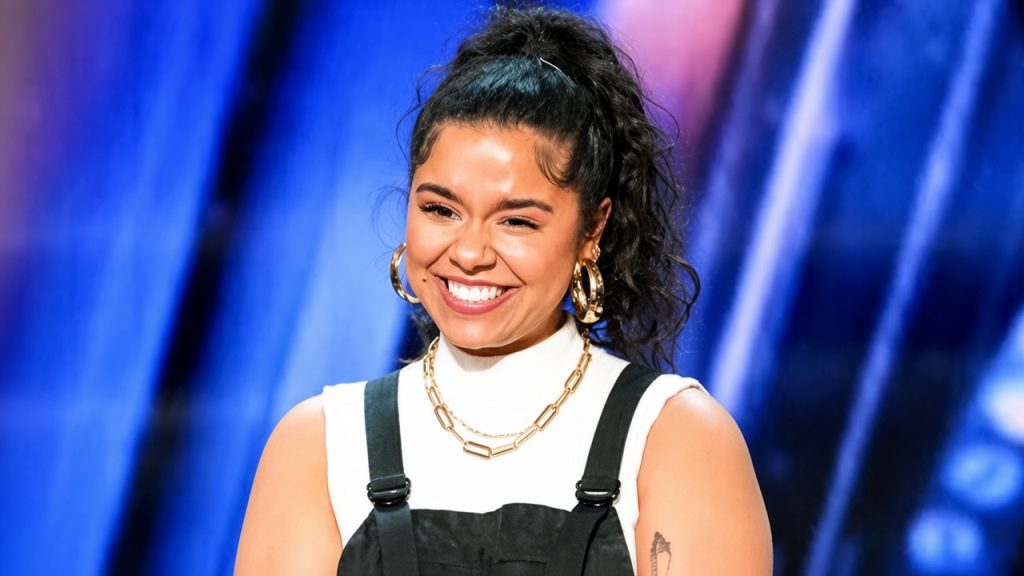
Brooke Simpson stepped onto the America’s Got Talent stage in 2021 carrying more than just a microphone. She was representing her community, her culture, and a dream she had been pursuing for years.
During her Season 16 audition, Simpson introduced herself as being from Hollister, North Carolina, describing it as a “super small indigenous community.” She also explained that her goal was to become the first major Indigenous pop star.
Then she started singing.
Who Is Brooke Simpson?
Brooke Simpson is a singer from North Carolina and a member of the Haliwa-Saponi tribe.
Before appearing on America’s Got Talent, Simpson had already gained national exposure through NBC’s The Voice. She competed during Season 13 in 2017 as a member of Team Miley Cyrus and finished in third place.
Her return to national television on America’s Got Talent gave her another opportunity to pursue a career in music while also bringing attention to her Indigenous background.
Simpson explained that representing her community was deeply meaningful to her. She had previously spoken about how being on television could help people learn about a tribe that many viewers might not know.
Brooke Simpson’s “Cuz I Love You” Audition
For her America’s Got Talent audition, Brooke chose Lizzo’s “Cuz I Love You.”
The song gave her plenty of room to showcase her vocal power, and she delivered a performance that immediately drew attention from the judges.
Coverage of the audition reported that all four judges gave Simpson a standing ovation. WITN reported that her performance earned the reaction from Simon Cowell, Howie Mandel, Heidi Klum, and Sofia Vergara.
Her voice was already familiar to fans of The Voice, but America’s Got Talent introduced her to another television audience.
The Story Behind Her Performance
What made Simpson’s audition especially personal was the story she shared before singing.
She explained that she came from a very small Indigenous community and wanted to make her tribe proud. In the audition transcript, Simpson described Hollister as a “super small indigenous community” and said she wanted to become the first major Indigenous pop star.
That context gave the performance an additional layer.
She wasn’t simply trying to advance in another singing competition. She was also using a major television platform to represent a community that she felt was often overlooked.
The Seminole Tribune previously quoted Simpson discussing this experience after her time on The Voice. She said her success gave her tribe recognition and eventually made her feel that she was representing Indigenous people more broadly.
The Judges’ Reaction
The judges responded strongly to Simpson’s performance.
WITN reported that she received a standing ovation from all four judges. MJSBIGBLOG also reported that Simon Cowell compared the audition to the appearances of major singers such as Kelly Clarkson and Fantasia on American Idol, while Heidi Klum said Simpson had “the whole package.”
Those comments reflected what made Simpson’s audition stand out: her vocal ability was paired with an established performance background and a clear personal goal.
The audition also demonstrated that Simpson was not a newcomer to televised singing competitions. Her previous experience on The Voice had already given her a national platform.
From The Voice to America’s Got Talent
Simpson’s America’s Got Talent appearance was actually her second major NBC singing-competition chapter.
In 2017, she competed on The Voice and became one of Team Miley Cyrus’s finalists, ultimately finishing third.
Four years later, she returned to television competition through America’s Got Talent.
This time, her objective was different. Simpson spoke openly about wanting to become a major Indigenous pop star and to serve as an example for other people from Indigenous communities. Deseret News reported that she described herself as aspiring to be the “first major indigenous pop star.”
Her AGT journey ultimately carried her much further than the initial audition.
Brooke Simpson’s AGT Journey Continued
Simpson advanced through Season 16 and eventually reached the finale.
During the competition, she performed songs including Billie Eilish’s “Lost Cause,” Ed Sheeran’s “Bad Habits,” and Bishop Briggs’ “White Flag.” The official AGT YouTube channel published her “Lost Cause” performance, describing it as a powerful cover.
For the finale, Simpson performed “White Flag” by Bishop Briggs. WITN reported that she ultimately finished fourth in the competition, while magician Dustin Tavella won the season.
Her fourth-place finish meant that she did not win the competition, but her AGT appearance gave her another major platform to showcase her voice and heritage.
More Than Just a Singing Audition
Brooke Simpson’s AGT audition is memorable because the performance and the story behind it work together.
Her connection to the Haliwa-Saponi tribe was not simply a detail added to her biography. Simpson made it part of her reason for performing.
She wanted people to know about her community and hoped her career could create greater visibility for Indigenous people.
That message had already been important to her during The Voice, where she discussed how appearing on television could bring recognition to a community that many people did not know existed.
Her AGT audition gave her another opportunity to share that story with a much larger audience.
Final Thoughts
Brooke Simpson’s America’s Got Talent audition combined a powerful vocal performance with a deeply personal story.
As a member of the Haliwa-Saponi tribe from North Carolina, Simpson used the AGT stage to pursue her dream of becoming a major Indigenous pop star. Her performance of Lizzo’s “Cuz I Love You” earned a standing ovation from all four judges and sent her forward in the competition.
Her journey eventually took her to the Season 16 finale, where she finished fourth. But the audition remains an important moment in Simpson’s television career — one where a singer from a small Indigenous community stepped onto a huge stage and made her voice heard.